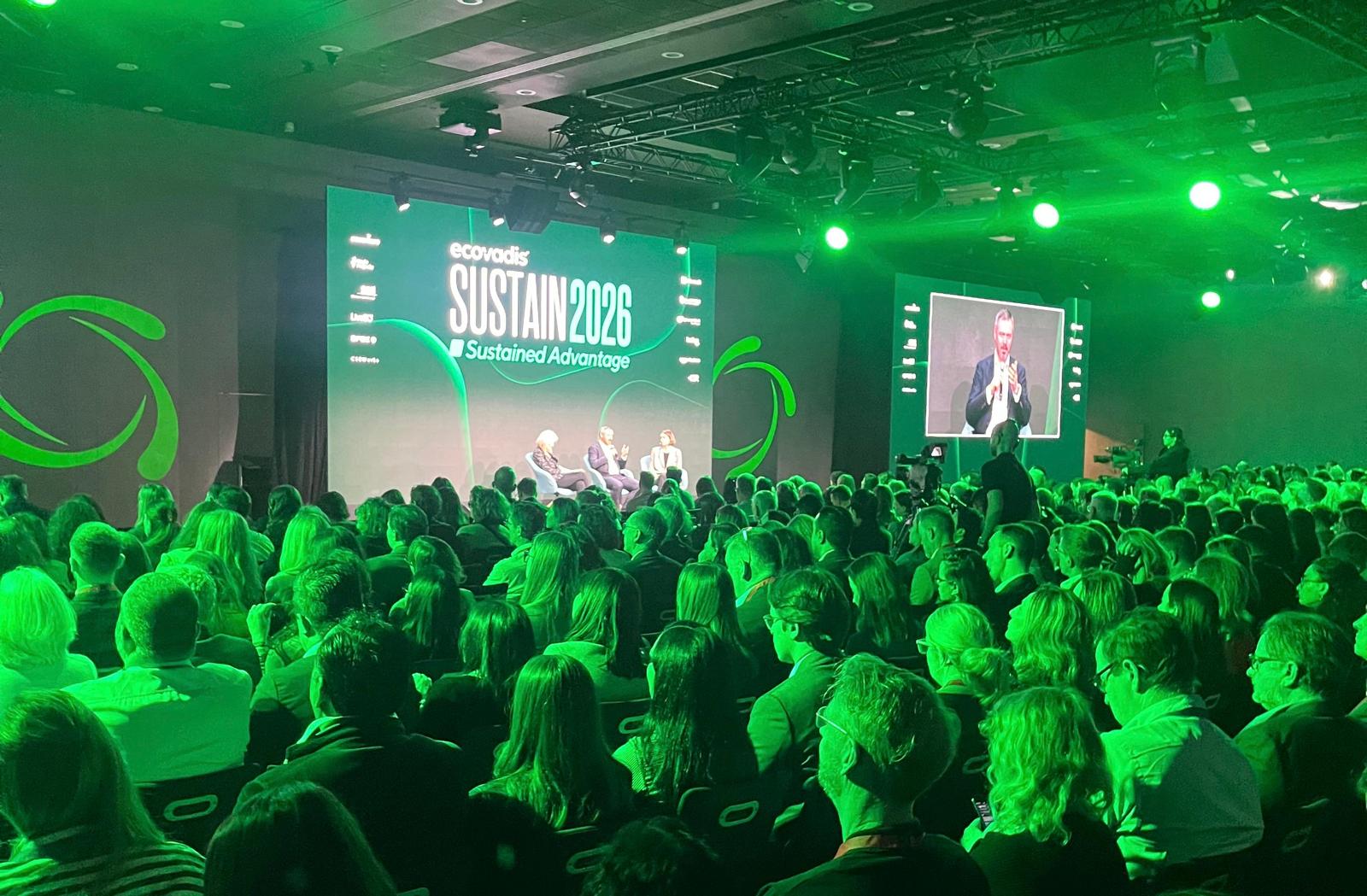
EcoVadis Sustain 2026 is undoubtedly one of the leading conferences for professionals working at the intersection of sustainability, procurement, and supply chain transformation. The event brought together business leaders, sustainability experts, and technology innovators to discuss how companies can turn sustainability commitments into real operational impact.
To reflect on the key insights from the event, we sat down with Sabrina Hueren, Senior Manager – Strategy Consultant, and Rahul Rao, Sustainability Consultant, to share their perspectives and takeaways.
Q: Among EcoVadis’ partners, Sourcing Champions is a procurement consultancy. What is the key takeaway for procurement leaders?
“In simple terms, procurement has now become the engine of sustainability,” Sabrina concluded in a bold yet difficult-to-dispute statement.
“Today, around 81% of business leaders say ESG factors influence their purchasing decisions. That means sustainability is increasingly embedded directly into sourcing and supplier selection. Every purchasing decision now carries implications not only for cost and performance, but also for environmental and social impact.” She further explained, quoting statistics raised by Blake Westerdahl, Senior Manager, WW Socially Responsible Purchasing of Amazon Business.
“By integrating sustainability criteria into supplier evaluation, contracting, and purchasing decisions, procurement teams can drive change across entire ecosystems of suppliers.”
Q: Why should organizations strive for sustainable procurement?
“First, businesses have a responsibility to operate sustainably,” Sabrina explained. “The world is facing increasingly visible climate and environmental challenges, and companies cannot ignore the role they play in addressing them.”
She pointed out that procurement is often the function that experiences the impact of these challenges first-hand.
“As Paul Polman noted, procurement is on the front line of disruption. When environmental shocks occur, the effects are immediately felt across supply chains. Procurement teams are the first to see how vulnerable global value chains can be.”
However, sustainability in procurement is not only about responsibility. It is also increasingly about value creation.
“At Sourcing Champions, we approach procurement through our 15M Procurement Transformation Framework, which embeds multiple value contribution targets into the procurement process. These include objectives such as cost and efficiency, but also broader goals like ESG performance, resilience, and growth.”
Sabrina emphasized that these goals are not in conflict with each other.
“In reality, sustainability and growth often reinforce one another. Companies generating around 50% green revenue have been shown to attract roughly 12–15% more value than those that do not, and the green economy has become the second fastest-growing sectors globally” she quoted statistics cited by Polman.
“This clearly reflects the theme of the event, Sustained Advantage, as sustainable practices truly create a competitive advantage,” Rahul added.
Q: Sustainable procurement sounds promising, but I imagine it comes with its own bottlenecks. What are the main challenges, and how can procurement teams address them?
“One of the biggest challenges is simply identifying and evaluating sustainable suppliers. For many procurement teams, it can be difficult to understand which suppliers truly meet sustainability standards,” said Rahul.
According to him, one of the most effective ways to reduce this friction is integrating sustainability data directly into procurement processes.
“This is where our partner, EcoVadis, can be particularly helpful. By integrating EcoVadis ratings into procurement process, sustainability data becomes available at the point of decision-making. Buyers can immediately see a supplier’s rating and incorporate that into their purchasing decision,” he explained. “And because the rating methodology is transparent, procurement teams understand what contributes to a supplier’s score and prioritizing the areas that matter most for their organization.”
Another key benefit is traceability and reporting.
“Once sustainability data is embedded in the procurement process, companies can track purchasing decisions over time and measure progress toward their sustainability objectives. Every purchase becomes part of the organization’s broader sustainability journey.”
Discover our Ecovadis Assessment & Enablement program
Q: Are there any recent developments that are helping accelerate sustainable procurement?
Rahul pointed to one major driver that is rapidly reshaping the landscape: artificial intelligence.
“AI is already starting to play a meaningful role in addressing both climate and operational risks across supply chains,” he explained. “For procurement teams, the potential lies in using data and predictive capabilities to make more informed and proactive decisions.”
He highlighted several practical applications that are already emerging, including:
- Forecasting environmental risks, such as wildfires or floods that could disrupt supply chains
- Reducing emissions in high-impact sectors, such as transportation and logistics
- Improving risk visibility across supplier networks,
However, Rahul cautioned against viewing AI as a simple or automatic solution.
“AI can be a powerful enabler, but the effectiveness of AI depends on the quality of the data behind it,” noted Rahul.
He also emphasized that human judgment remains essential.
“Supply chains involve complex trade-offs. AI can help surface insights and reduce noise, but human expertise is still critical when it comes to making those strategic decisions.”
Q: Any closing remarks from the event?
“We learned a great deal,” Sabrina reflected. “It’s encouraging to see that our partner EcoVadis, together with many organizations across procurement, investment, and other industries, is moving in the same direction toward sustainable procurement excellence.”
Rahul added that the broader momentum around sustainability was one of the most striking takeaways from the event.
“As Helena Helmersson nicely put it, we are moving toward the slope of enlightenment in sustainability. This is the stage where real value begins to emerge, partnerships are formed, solutions mature, and attention grows. Most importantly, this is when impact starts to accelerate.”
Sabrina concluded on an optimistic note:
“There is still a long road ahead, but we are both enthusiastic and proud to help organizations turn sustainability into a true competitive advantage.”