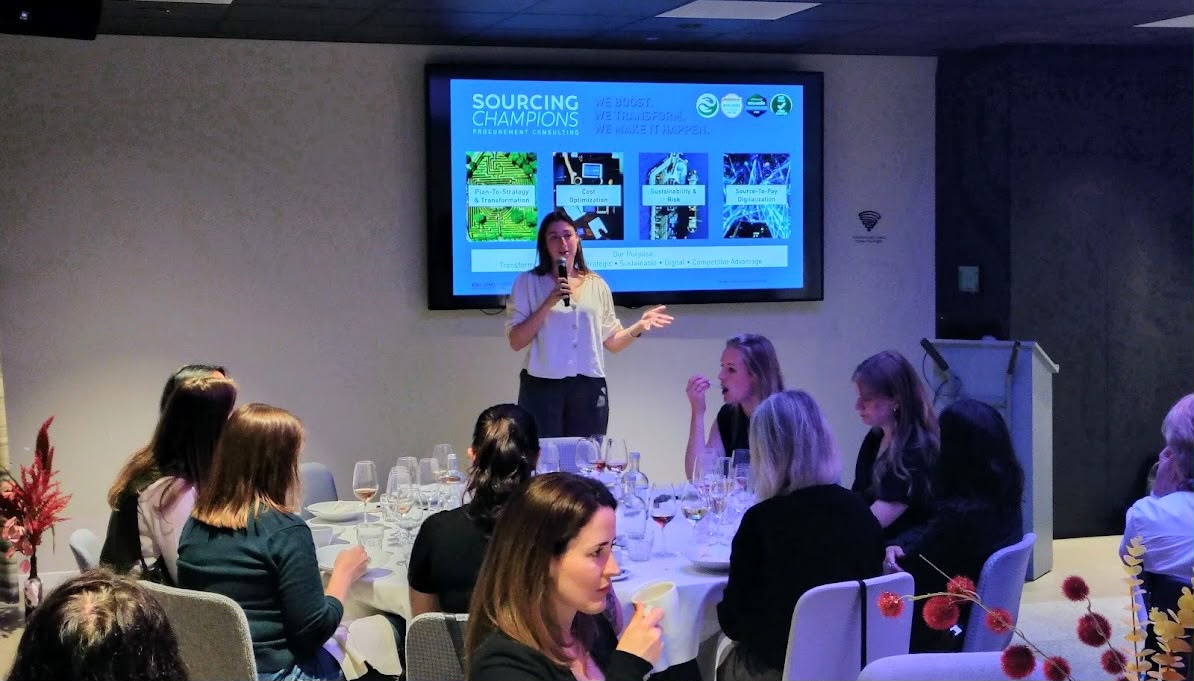
In May, Ivalua hosted a “Women in Procurement” dinner in the heart of Amsterdam, bringing together top talent from across the procurement field, once a predominantly male-dominated industry, spanning early-career professionals to CPOs. The discussion was led by Monique Beersma from Royal Avebe, Maria Antonova from Teva, and Vivianne Courte-Rathwell from Sourcing Champions, who facilitated the conversation and is featured in this interview.
Challenges and opportunity
“I think the most valuable part of this event is bringing women procurement professionals together and creating an open space for honest conversations,” said Vivianne. “We had the opportunity to discuss not only the challenges we face but also the opportunities ahead.”
In 2024, Gartner reported that women make up around 40% of the supply chain workforce, a significant proportion in the industry. Yet many still face challenges in their day-to-day work.
“A common theme I observed through the conversations is the navigation of the requirement to adapt behavior and communication based on the audience” said Vivianne, “For example, the tone and approach to managing stakeholders as an IT buyer where it is a traditionally male-dominated field, versus as a Marketing buyer , an increasingly female led field, underlying biases can still impact our work.”
That said, Vivianne sees the increasing number of women in procurement as a positive trend. Through her conversations with leading professionals, she observes that meaningful change is taking place and that there are growing opportunities for progress. These discussions have also helped her learn how to navigate and succeed within this evolving environment.
Language of Stakeholder Management
“Of course, you need to stand your ground and stay true to yourself, regardless of your gender identity or expression. Everyone deserves to be treated with respect,” said Vivianne. “At the same time, we need to balance this with our ability to influence others. In project management terms, that means speaking the language of stakeholder management.”
Vivianne emphasizes that navigating procurement, especially in a traditionally male-dominated environment, requires strong stakeholder awareness and the ability to adapt communication styles to effectively influence different audiences. This should never come at the cost of changing who you are or conforming to patriarchal expectations. Femininity should not be mistaken for vulnerability or indecisiveness; rather, by striking this balance between authenticity and influence, women are actively reshaping the norms of the industry.
“Honestly, as women, we’ve been navigating this balance throughout our lives. In procurement, implementing stakeholder-attuned communication becomes even more pronounced, because of the amount of negotiations and stakeholder management, requiring continuous learning and adaptation,” added Vivianne. “But ultimately, this will lead to progress for women in procurement and, by extension, greater gender equality as a whole.”
Learning through Open Conversation
Vivianne emphasized the value of the event in creating an open and supportive space where women can speak candidly with one another. She highlighted how rare and important it is to have an environment that encourages honest dialogue, shared experiences, and mutual learning across different stages of their careers.
“It was an incredibly valuable experience, and I strongly believe there should be more initiatives like this to support ongoing dialogue and connection.”
A special thank you to Ivalua for bringing this initiative to life and for supporting conversations that help drive both individual development and broader progress in the industry.